
Why the "Calming Colors for Home" Advice You Read Online Isn't Working
- Mar 10
- 6 min read
Updated: Mar 13

You spend hours scrolling Pinterest, saving airy living rooms and "calm" bedrooms. You buy the samples everyone recommends for a calming home, paint the walls, rearrange the furniture… and somehow the room still feels off. Not terrible. Just not you.
Maybe you feel oddly restless in a room that's supposed to be relaxing. Maybe you've repainted more than once, or you keep buying new pillows and rugs, hoping this will fix it.
If that sounds familiar, you're not bad at color. You've just been given someone else's rules.
The problem isn't your taste. The problem is the advice itself.
Some signs you're following generic color rules instead of your own:
You've painted a room more than once and it still doesn't feel right.
Your home looks "nice" to other people but you don't fully relax there.
You keep buying cushions, rugs, or art hoping they'll fix the feeling that something is missing.
You find yourself posting photos online asking strangers, "Which color should I choose?"
The Interior Design Industry Has Been Giving You Someone Else's Color Rules
The biggest pain point in decorating a home is the paralyzing fear of making a mistake. To avoid getting it wrong, most of us default to copying trends or following standard color psychology rules. Blue is calming. Green is natural. White is clean and safe.
So you pick the "calming" color the internet swears by… and in your house it feels cold, boring, or vaguely wrong. You assume you chose the wrong shade, not that the rule itself might not apply to your history or your space.
Those rules weren't written for your nervous system. They were written for an average that doesn't exist.

The Trap of the "Safe" White Room
When we're afraid of getting color "wrong," we almost always default to white, beige, or grey. They feel resale-friendly, landlord-approved, and impossible to mess up. Friends, realtors, and even designers reassure us that neutrals are the safest calming colors for home walls.
The problem is that what looks safe in a listing photo can feel strangely draining to live in day after day.
White walls reflect up to around 97% of light, which means your eyes are constantly working to process that intensity. The tiny muscles in your eyes keep adjusting and contracting, leading to visual fatigue, tension, and headaches. Your "relaxing" room is physically exhausting to be in.
Beyond that, our brains evolved in nature, where vertical surfaces like trees and foliage reflect much less light and are rich in dynamic, shifting color. A static white room is the neurological equivalent of sensory deprivation. Psychologists describe this as a hypostimulating environment, one that lacks enough visual input for your brain to regulate properly. The result: restlessness, difficulty concentrating, and a subtle but persistent feeling of unease that you can't quite name.
This is why you repaint, redecorate, and rearrange, and still feel like something is missing. The room looks fine. Your nervous system just isn't convinced.
The Myth of Universal Color Psychology
So if white isn't the answer, why not just use a "calming" blue or green?
Because our emotional responses to color are largely learned, not innate. We aren't born with pre-programmed reactions to specific shades. The idea that blue is universally relaxing or red is universally energizing is a cultural shorthand — not a biological guarantee.

Here's what's actually happening: every time you experience an intense emotion, your subconscious mind records the sensory details of that moment, including the colors in the room. Through what psychologists call implicit memory, your brain forms deep, unconscious associations between specific shades and specific feelings.
If you went through a painful or stressful period in a room painted sage green, your brain may have logged that exact shade as unsafe. Years later, painting your living room that same green, the color every design blog recommends as a calming color for home, can trigger a subtle, inexplicable anxiety you can't explain.
Conversely, if your warmest childhood memories happened in a home full of rich, warm ochre and terracotta, those "bold" colors might be exactly what makes you feel at ease.
The color isn't the problem. The mismatch between the color and your personal history is.
How to Find the Calming Colors That Actually Work for You
We are predictive machines. Our nervous systems are constantly interpreting the present through the lens of the past. An environment can only feel truly safe and restorative if the colors within it represent safety and joy...to you specifically.
That means the path forward isn't finding the "right" color on a chart. It's looking inward.
Don't start with the color wheel. If you've ever stood in the paint aisle clutching a fan deck and feeling your brain shut down, this is why. The color wheel is a useful tool for combining and balancing colors — but only once you know which colors actually resonate with you. Using it as your starting point skips the most important step: figuring out which colors your nervous system responds to positively in the first place. Combination comes second. Connection comes first.
Look for the colors of your positive memories. Think back to moments when you felt most loved, secure, or at peace. What colors were in those spaces? Maybe it's the deep blue of your grandparents' cottage, the honey-gold light in your first apartment, or the clay-colored tiles from a favorite trip. This doesn't have to be a precise exercise — a general sense of warmth or coolness, richness or lightness, is enough to start with.
Notice your body, not just your opinion. When you look at a paint swatch or a fabric sample, don't just ask "is this pretty?" Ask: how does my body respond? Shoulders dropping, breath slowing, a quiet sense of "yes" — that's your nervous system telling you something. Tension in your jaw, a little knot in your stomach, or a vague sense of wrongness is also information. When you tape a sample to the wall and keep changing your mind every time you walk past, that's information too. Your nervous system is telling you it doesn't trust that color yet — even if it looked perfect on Pinterest.
When you surround yourself with the colors tied to your own positive memories and associations, your home stops being a stylish backdrop.
It becomes an environment that actively supports your nervous system — one that lets you exhale the moment you walk through the door.
What Calming Colors for Home Actually Look Like in Real Rooms
These aren't trend boards pulled from Pinterest. Every palette below was built from a real client's Color Discovery Session; the colors you see are the ones that came up again and again when they thought about their happiest, most grounded memories. No rules. No trends. Just their personal color history, translated into a room.
This is what it looks like when color actually fits the person living with it.


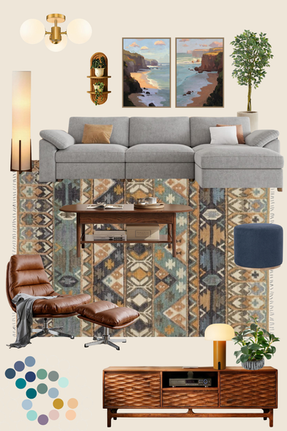


[Click on the image to shop the look]
Each of these palettes could feel perfect for one person and completely wrong for another. That's the point.
Not Sure Which Calming Colors Are Right for Your Home?
If you're reading this and thinking, "I genuinely don't know what my colors are, and I'm tired of guessing," that's exactly what my Color Discovery Session is designed for.
In 30 minutes, we untangle your mixed signals about color: the shades you love online but hate on your walls, the neutrals you keep defaulting to, and the bold colors you're secretly drawn to but scared to try. Using a psychology-based methodology that goes well beyond "what's your favorite color," we map your personal associations into a clear, specific direction for your home.
You leave with a grounded color roadmap, one based on your own history rather than a generic trend report, so you can stop repainting, stop panic-buying decor, and start making decisions you actually trust.
Your home should feel like you. Let's figure out what that actually looks like.




Comments