
How I Designed My Daughter’s ADHD-Friendly Bedroom for Calm and Regulation (Not Just Her Aesthetic)
- Apr 20
- 5 min read
Before she moved in, I had a list.
It came from her guardianship worker, who had sat with her and asked what she would want in her room. The answers were very her: pink, purple, and "the colors of Valentine's Day." A Taylor Swift poster. A cozy chair that hangs from the ceiling. Her stuffed panda, somewhere she could see him.
I read that list the way I read every client brief, looking for what was said and what was underneath it. A seven-year-old asking for a hanging chair is asking for something that holds her, something she can curl into and feel contained by. Valentine's Day colors are soft and warm and a little romantic. Not bold. Not sharp. Gentle.
She had never seen the room. She was describing, in the language available to her, what she needed to feel safe.
My job was to translate it into an ADHD-friendly, trauma-informed bedroom that felt soft, predictable, and safe enough for her nervous system to exhale.
The Room Had One Real Problem

The room is small. Before she arrived, it held a guest bed and a dresser and that was essentially it. There was no layout that could fit a bed, storage, a desk for crafts, and open floor space for play without the room feeling like a storage unit.
So I looked at what was there and asked what could be repurposed.
There was a closet.
The closet was 72 inches long. A standard twin mattress is 74. I stood there for a while looking at that two-inch problem and then thought: It'll squeeze in.
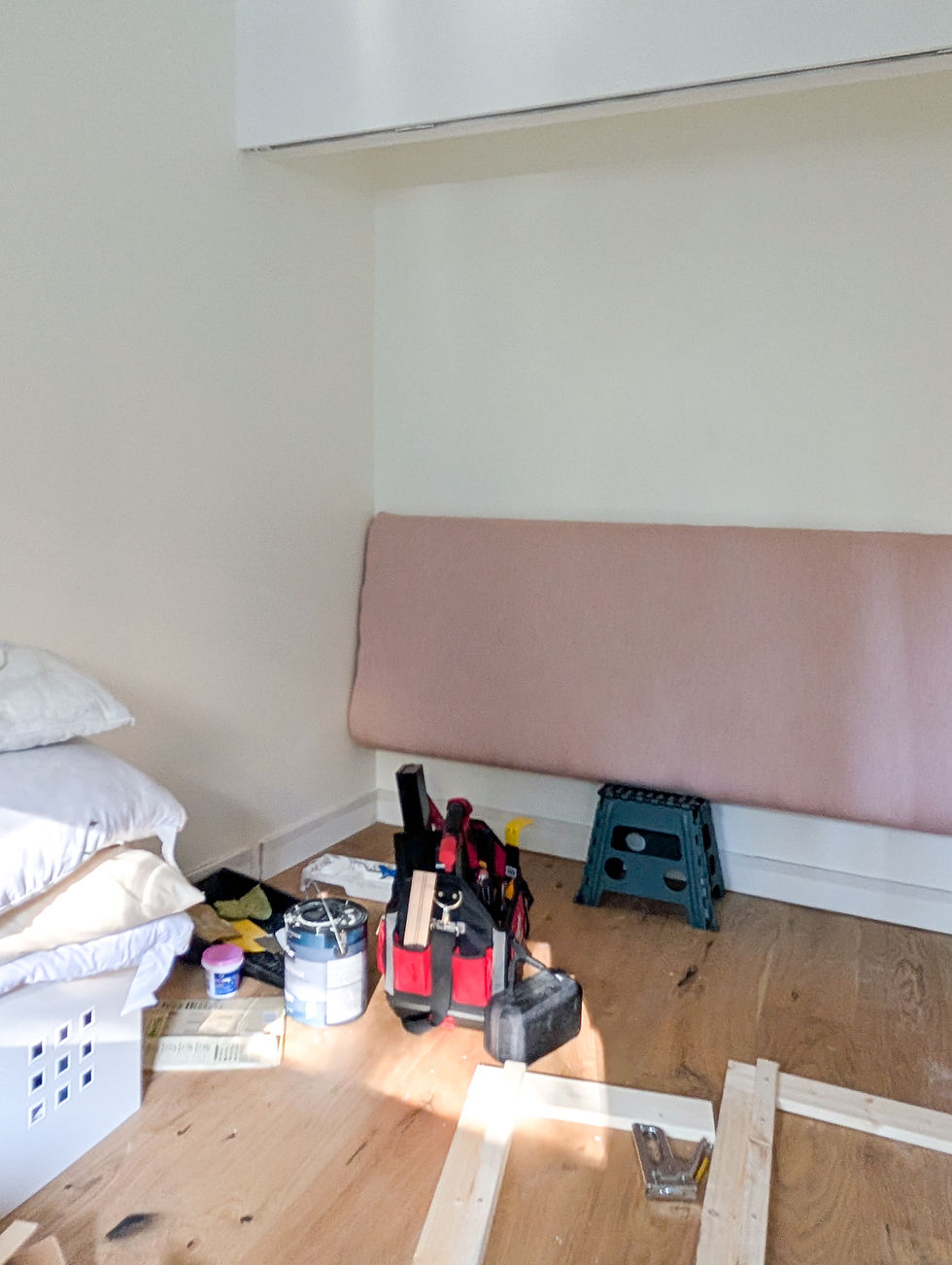
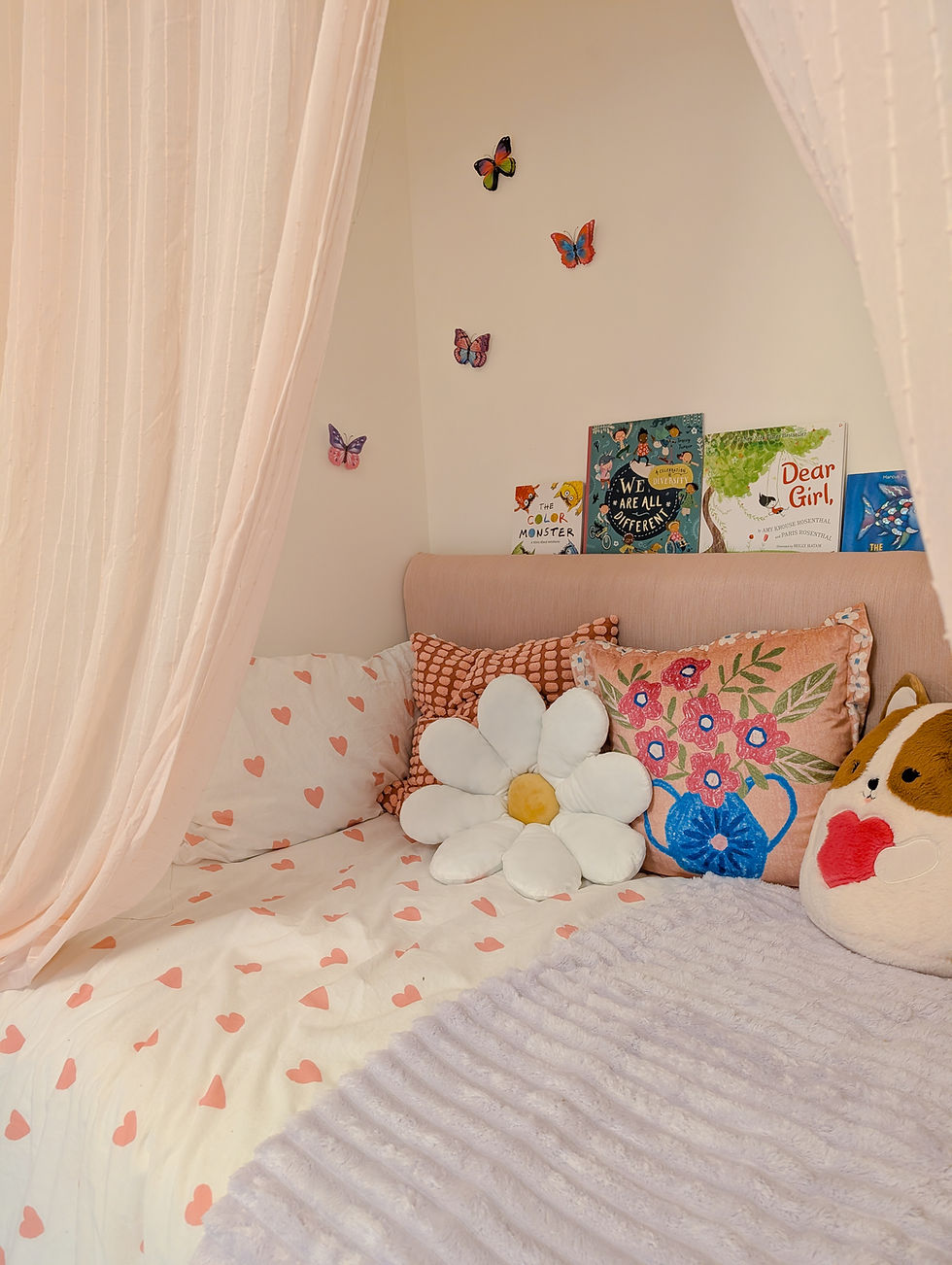
I removed the closet doors, built a small platform structure inside to make the fit work, and turned the closet into her bed. A nook with curtains she can draw closed, pillows stacked at the back, softness on every surface. Her stuffies have a place of honor right there with her.
On the other wall, a long desk runs the full length under the window. IKEA TROFAST units underneath so storage is built in and easy to clear. A pegboard above holds containers of pencils, markers, and notebooks, everything visible, everything ready. Nothing hidden in a drawer she'll forget about.
The result: the center of the room is completely open. She can play on the floor. She can spin. She can drag every stuffie out of the bed and build a fort and there is still room.
This is one of the quiet goals of an ADHD-friendly bedroom: enough structure to keep things findable, but enough open space that her body can move, fidget, and play without the room fighting her.
Why This ADHD-Friendly Bedroom Is Also Trauma-Informed
She seeks enclosure. A lot of kids do, especially kids whose nervous systems have learned that open, unpredictable environments are not always safe. Blanket forts. The space under the stairs. The corner of the couch with cushions piled around them.
That instinct is not random. It is the nervous system asking for a defined boundary, a space with clear edges that the brain can understand as contained and therefore safe. When the curtains are drawn, the world gets smaller in the best way. She knows where she is. That knowing is what lets her relax.
I designed for that instinct instead of working around it. That is what makes this room not just an ADHD-friendly bedroom, but a Trauma-informed design choice: it gives her a predictable, controllable pocket of space she can retreat to when everything else feels too big.
The Colors
She asked for pink and purple and Valentine's Day colors.
I kept the base soft: blush pink, lavender, warm cream. Nothing saturated, nothing sharp. And then the rug. It is covered in stars, not florals, which felt exactly right once I saw it. Valentine's Day colors, yes, but with a nod to the other thing she loves: Taylor Swift has owned the star motif for years. The rug does both things at once without announcing either one.
I also left room to add. The Taylor Swift poster she asked for, stronger pinks, more purple over time. The room has a foundation she can layer onto as she gets to know it, and as she gets to know us.
She has seen it only in pictures so far. She is obsessed with it!
The Textures

Every textile was chosen for how it feels, not just how it looks.
The ribbed lavender blanket. The heart print duvet. The faux sheepskin rug on the floor. The daisy pillow she can hold. These are not decorative choices. Tactile input is one of the ways a sensory-sensitive nervous system self-regulates. Having textures she can reach for, press her face into, wrap around herself, gives her body something to do with whatever she is carrying.
Think of it as a sensory menu rather than a matching set. Different textures for different moments. In an ADHD-friendly, Trauma-informed bedroom, those options matter more than perfect styling.
The Lighting
The room has a main overhead light, flower-shaped, which fits the room's personality without feeling clinical. But the overhead is only part of the story.
Layered around it: a purple flower wall light from IKEA for evenings and early mornings, fairy lights on a timer woven through the canopy, a desk lamp for craft time, and a small light on the nightstand. Each source serves a different moment in her day.
This layering matters especially at wind-down time. Bright overhead lighting signals alertness to the nervous system. Warm, diffuse, lower light signals that the day is ending. The transition from day to night becomes something the room does gradually, not something that arrives all at once as a switch flipped in the dark. She can move through the lighting instead of being hit by it.
This is one of the gentlest ways a room can support regulation: changing the light in stages so her body has time to follow.


What the Room Is Actually Doing
Every decision here is doing the same job: reducing the background work her nervous system has to do just to exist in the space.
The nook creates containment. The open center creates freedom. The textures give her body something to regulate with. The lighting eases transitions. The visible craft supplies remove the decision fatigue of figuring out where things are.
She didn't ask for any of those things by name. She asked for Valentine's Day colors and a hanging chair and a place for her panda.
I just listened carefully enough to hear what she meant.
The full product list from this room is below.




Comments