
Small Kitchen Organization: Why Your Kitchen Feels Chaotic (Even After Decluttering)
- Feb 13
- 11 min read
Updated: Feb 27
We've all been there. You're standing in the middle of your kitchen on a Tuesday morning. The coffee maker is gurgling, a child is yelling that they can't find their other sock, and you are frantically searching for the one specific lid that fits the one specific container so you can pack a lunch and get out the door.
In that moment of stress, you look around and think, "I need to get organized."

Your brain immediately flashes to that Instagram reel you saw last night—the one with the rainbow-coordinated snacks, the acrylic risers for the canned goods, and the custom-labelled jars for everything from quinoa to pretzels. You think, "If I just had those bins, my life would be calm. My kitchen would work."
Here's the truth: Sometimes the right product helps. But most of the time? What you actually need is clarity about what's broken—and it's rarely the storage.
Small kitchen organization isn't about buying more containers—it's about understanding why your space is fighting you in the first place.
If your kitchen feels chaotic, chances are you have a workflow problem disguised as a storage problem...
Why This Isn't About Being "Organized Enough"
Before we talk about solutions, let's talk about what's actually happening in your body when your kitchen feels chaotic.
Your nervous system is constantly scanning your environment for cues of safety or danger—a process called neuroception that happens automatically, beneath your conscious awareness. When you walk into a room with visual clutter, your brain registers it as a threat signal. Not a real threat, but your autonomic nervous system doesn't distinguish. Clutter activates the same stress response as actual danger.
This is why you can feel anxious in your kitchen even when nothing is objectively "wrong." Your nervous system is responding to environmental chaos the same way it would respond to an unsafe situation.
Research backs this up. A UCLA study found that when women described their homes as "cluttered," their stress hormones (cortisol) measurably increased. This isn't about being "dramatic" or "sensitive." This is neurobiology.
So when I say your kitchen is stressing you out, I mean it literally—your body is in a state of low-grade, chronic stress response. And no amount of pretty bins will fix that if the underlying workflow is broken.
If your kitchen feels chaotic, chances are you have a workflow problem disguised as a storage problem. And once you understand the difference, you'll know exactly what's worth buying and what's not.
The "Pinterest Pantry" Trap

Let's talk about the aesthetic organization trend. You know the look—rows of perfectly front-faced products, decanted cereals, and specialized holders for everything. I once saw Khloe Kardashian's pantry where she had a glass jar with Oreos stacked in perfect, symmetrical rows—each cookie perfectly aligned like little soldiers.
It is visually satisfying. Our brains release dopamine when we see symmetry and repetition. But here's what nobody mentions: there's a difference between performative organization and functional organization.
When you buy a bin to hold your other bins, or a specific gadget to hold a specific snack, you're adding maintenance to your life. Now, instead of just grabbing a box of crackers, you have to wash, dry, and refill a specialized canister. You've created a part-time job for yourself.
Those "aesthetic" playrooms and pantries often look stunning but require constant upkeep—a level of maintenance that's realistic for some households and exhausting for others.
If this feels hard, it's not you. It's that the system wasn't designed for your real life.
Workflow vs. Storage: Understanding the Difference

Before you buy anything, let's diagnose what's actually happening in your kitchen.
Storage is where you put things—the drawer where the spatula lives.
Workflow is how you use things—it's the invisible line you walk between the fridge, the sink, and the stove while making dinner. In design terms, we call this the "Kitchen Work Triangle." This strategic arrangement optimizes movement between your cold storage, your cleaning zone, and your cooking zone.
Here's why this matters neurologically: Your brain maps repeated movements. When you have to zigzag across the room every time you cook, you're creating cognitive friction—your brain can't automate the pattern, so every meal requires active decision-making. This burns mental energy.
When your kitchen feels chaotic, it's usually because your workflow is broken, creating "friction."
Friction is anything that interrupts your flow. It's the drawer you can't open because the oven door blocks it. It's having the spices on the other side of the room from the stove. It's having to move three stacks of "just in case" Tupperware to get to the one mixing bowl you use every day.
Friction isn't just annoying—it's depleting. Every time you encounter an obstacle, your brain burns glucose making a micro-decision. By the end of the day, you're mentally exhausted from navigating a poorly designed space.
If you try to fix a workflow problem with a storage product, you're just organizing your frustration. You're making the obstacles prettier, but you aren't removing them.
My Diagnostic Approach: The "Why" Before the "How"
Before you spend a single dollar, we need to diagnose why your space is fighting you. This is what separates clarity from chaos.
Here is the three-step diagnostic audit I use:
1. The Sight Line Check
Research shows our brains judge a room's cleanliness in under 3 seconds—some studies say as fast as 25 milliseconds. This is your "first impression" bias.
But here's what's really happening: Your nervous system scans for safety within milliseconds. When it sees chaos, it activates your stress response before you're even consciously aware. This is neuroception at work.
Stand in the doorway of your kitchen. What is the very first thing your eye hits? This is your Sight Line. If that spot is cluttered—if there are piles of mail on the island, or appliances crowding the counter right in your visual path—your brain immediately registers the entire room as "messy" and "stressful."
The Fix: Clear the sight line first. You don't have to deep clean the whole kitchen. Just clearing that one visual anchor point lowers your cognitive load and signals safety to your nervous system.
2. The Friction Audit
For one week, pay attention to when you feel annoyed in your kitchen.
Do you have to walk across the room to throw away a tea bag because the trash isn't near the sink?
Do you have to unstack three heavy pans to get to the one you need?
Do you constantly leave the toaster out because putting it away is too much hassle?
These are friction points. They usually indicate that items are stored based on where they fit, not where they are used.
The Fix: Apply the concept of "One Zone, One Job."
The Prep Zone: Keep knives, cutting boards, and mixing bowls between the sink and the fridge.
The Cook Zone: Pots, pans, and spices should be within arm's reach of the stove.
The Clean Zone: Trash, recycling, and soaps belong near the sink.
Even in the tiniest kitchen, grouping items by activity rather than category reduces chaos. Keep your coffee mugs near the coffee maker, not across the room with the water glasses just because they are both "cups."
Reality check: In small kitchens, you can't always have everything within arm's reach. Maybe your coffee maker is on one counter and the sink is across the room—you'll have to walk for water. That's okay. The goal is to group what you can control. If the mugs, coffee, sugar, and filters are all together at the coffee station, you've eliminated several unnecessary trips even if one necessary trip (to the sink) remains.
For neurodivergent brains (especially ADHD): "Out of sight, out of mind" is real. If you have ADHD, open shelving or clear containers might work better for you than closed cabinets, even if it's not Instagram-pretty. Visibility supports your brain. Don't fight your neurology to follow someone else's aesthetic rules.
3. The "Just in Case" Interrogation
This is the hardest part, but it's also the most freeing.
We often keep things for the person we wish we were, not the person we are. We keep the pasta maker because we aspire to be the kind of person who makes fresh linguine on a Tuesday. We keep the fancy margarita glasses because we want to be the kind of person who hosts effortless cocktail parties.
This is called "aspirational clutter," and it's taking up prime real estate in your home.
The Fix: Be honest. If you haven't used it in a year, ask yourself: Is this actually serving me, or is it just taking up space? You don't need to organize your way out of excess—sometimes the kindest thing you can do is let it go.
Want a step-by-step checklist to diagnose what's actually broken in your kitchen? I've created a free Small Space Kitchen Quick Wins Guide that walks you through the exact audit I use. It includes a sight line worksheet, friction tracker, and decluttering decision tree. Download it here →
Small Kitchen Organization Products That Actually Help (And Why They Work)
After making every expensive mistake in the book, here's what actually earned its place in my kitchen. Notice the pattern: these aren't aesthetic choices. They're workflow fixes that happen to also look better.
1. Rectangular Lazy Susan for the Fridge (Amazon link)

This changed my life. Before this, I'd open the fridge and immediately feel overwhelmed—jars shoved to the back, condiments hidden behind milk, expired food lurking in corners.
Why it works for your nervous system: When you can see everything at a glance, your brain gets a "safe" signal. Predictability = safety. You spin the turntable, everything is visible, decision fatigue drops.
Best for: Condiments, jars, anything that tends to get lost in the back of the fridge. The rectangular shape maximizes space better than round in most fridges.
2. Round Lazy Susan for Upper Cabinets (Amazon link)
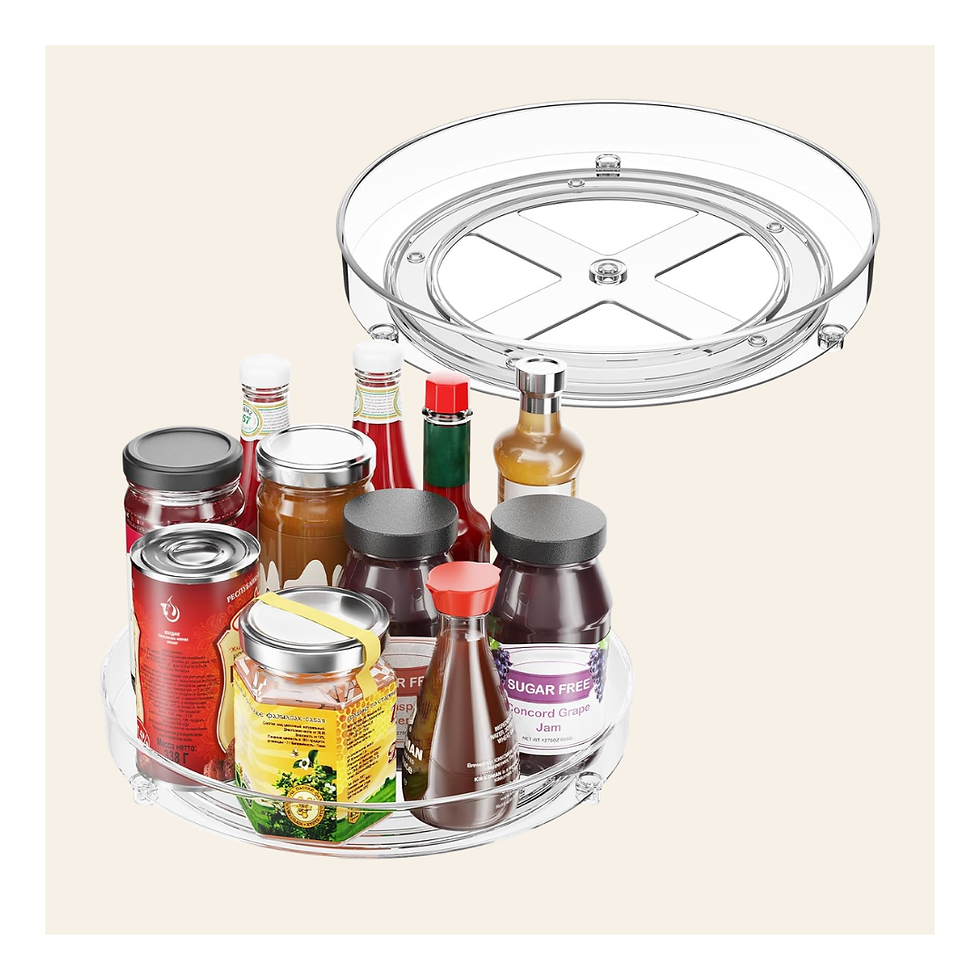
This is gold for upper cabinets where you can't see what's in the back. No more knocking over three spice jars to reach the one you need.
Why it works: Reduces cognitive load. Instead of scanning 30 bottles, you spin and grab. Your brain doesn't have to work as hard to locate what it needs.
Best for: Spices, oils, vitamins—anything you use regularly but tends to hide in deep cabinets.
3. Drawer Pegboard System (Amazon link)

I use this to organize food storage containers and lids in a drawer. Before this, opening that drawer was instant chaos—lids everywhere, containers tumbling out.
Why it works: Creates designated spots for each container size. Your brain loves categorization. When everything has a home, you're not making micro-decisions about where to put things back. This is friction removal at its finest.
Best for: Food storage containers, baking supplies, anything that tends to become a jumbled mess in drawers.
4. Cabinet Shelf Riser (Amazon link)

These double your vertical space in upper cabinets. I use them for plates, mugs, and pantry staples.
Why it works: Visual clutter competes for your attention. When you stack plates directly on top of each other, you create unnecessary visual noise. A riser lets you see both levels at once, reducing the mental load of scanning.
Best for: Plates, mugs, canned goods, pantry items—anywhere you need to maximize vertical space without creating dig-through-the-pile chaos.
5. Nice Countertop Container for Cooking Tools (Amazon link )

Here's the truth: I don't have a drawer for my cooking tools next to the stove. And since I use them every single day—spatulas, wooden spoons, tongs—I keep them in a container right next to my cooking zone.
Why it works: When you don't have enough drawer space, strategic countertop storage is okay. The key word is strategic. These tools live where I use them. I'm not adding an extra step of storing them away just to jam them into a distant drawer.
The "pretty matters" principle: A nice container keeps everything together visually and functionally. It's not clutter—it's a tool station. This is when aesthetics support function.
Best for: Daily-use items that belong near their zone of use—cooking tools by the stove, coffee supplies at the coffee station, dish soap and sponge by the sink.
The Decanting Decision: When It's Worth It (And When It's Not)
Let's talk about this specifically, because it's where I see the most confusion.
When to Decant:
Flour, sugar, rice, pasta, and baking supplies that you scoop regularly. Square or rectangular containers are more space-efficient than bags or boxes, and they keep ingredients fresh longer.
Here's my take on open shelving: I know the internet is divided on this, but I'll be honest—open shelves can work. A kitchen full of upper cabinets can feel heavy and closed-in, especially in small spaces. Open shelves create visual breathing room.
The key: Open shelves are not just for decorative items. Use them for pretty and functional storage. I keep frequently used items like pasta, flour, and grains in glass containers on open shelves. They look good, and they're easy to access.
The hierarchy of open shelf storage:
Top shelves (hard to reach): Decorative items, serving pieces you use occasionally
Middle shelves (eye level): Pretty glass containers for daily-use ingredients (pasta, rice, flour)
Bottom shelves (most accessible): Everyday dishes, mugs, things you grab constantly
When NOT to Decant:
Goldfish crackers, cereal, snacks that rotate frequently, or anything with cooking instructions you reference. The original package has the expiration date, ingredient list, and directions. Keep it simple.
Permission slip: If washing and refilling containers feels like a chore you dread, that's important information. Honour it. Instagram made you think decanting is mandatory. It's not.
Small Kitchen Organization Strategies (That Cost Nothing...or almost)
Let's fix the workflow issues first. You might find you don't need to purchase anything at all.
1. Create Drop Zones
Chaos often happens because things enter our homes and don't have a place to land. We come in tired, and we drop keys, mail, and bags on the nearest flat surface. This is natural human behavior.
Instead of fighting it, design for it. Create a designated "Drop Zone" at the entryway or the end of the counter.
Why it works for your nervous system: When you designate a specific place for things to land, you're creating predictability. Predictability signals safety to your nervous system, allowing it to move from a stressed state into calm.
When you contain the chaos to one specific tray or basket, it stops reading as mess and starts reading as a system.
2. Use Vertical Space
If your counters are full, look up. We often ignore the vertical space in our kitchens. Can you use a magnetic knife strip to get the knife block off the counter? Can you put hooks under a cabinet for mugs? Using vertical space clears the "working plane" (your counters), which immediately makes the room feel larger and more functional.
3. The "One In, One Out" Rule
This is the golden rule of small space living. If you buy a new spatula, an old one has to leave. If you buy a new mug, a chipped one gets donated. This stops the slow creep of accumulation.
The Bottom Line: Trust Your Reality
Here is the truth: You don't need a bigger kitchen. You don't need a custom pantry system.
You need a kitchen that respects the way you actually live.
If you are a baker, you need your flour on the counter, not hidden in a high cabinet for the sake of "minimalism." If you have kids, you need plastic cups in a low drawer where they can reach them, not displayed on an open shelf.
Your home is not a showroom. It is a space designed to support you.
When we stop trying to mimic the curated images we see online and start designing for our actual workflows—our real, messy, human behaviors—the chaos subsides.
So, take a deep breath. Look at your sight lines. Identify the friction points. Be honest about what you actually use.
And if you do need to buy something? Buy it intentionally. Buy it because it solves a specific problem you've diagnosed, not because it promises to solve everything.
You've got this.
Ready to Fix What's Actually Broken?
Download my free Small Space Kitchen Quick Wins Checklist—a step-by-step guide to diagnosing workflow problems before you buy another storage product.
Inside you'll get:
The Sight Line Worksheet – Identify what's triggering your stress response
The Friction Audit Tracker – Find the hidden workflow problems in your kitchen
The Decluttering Decision Tree – Know what to keep and what to let go
Plus, get weekly design tips that teach you the why behind what works (and what doesn't) in small spaces. I bridge nervous system science with practical home design—no fluff, no trends, just what actually supports your real life.


Comments